Creative Advertising Still Has a Market in China — Heinz Just Proved It
By The Olivia
Independent Content Strategist for the China Market
This post is part of the “Marketing in China” series. Click here to view the series introduction and why it was created.
There’s a widely shared understanding in China’s advertising world.
Both clients and agencies know this: most ads in China simply don’t get watched.
In the past few years, traditional creative budgets — TVCs, key visuals, and offline posters — have been shrinking every year. Even when the total marketing budget stays the same, more of it gets pushed to short videos, operations, and paid performance.
This makes creative teams harder to run, less valued, and less able to experiment.
But can brands stop doing creative work entirely?
No.
Partly because creative assets still represent the brand’s positioning. And partly because “people don’t watch ads” does not mean “ads don’t generate returns.”
Most ads in recent years follow a few common patterns:
- Repetition. Running the same message again and again until people remember it.
- Puns and wordplay.
- Celebrity endorsements. Still the most used and often the most efficient.
I’m not saying these approaches are wrong.
If the purpose of an ad is to drive sales — and it delivers — then it’s a successful ad. Creative dreams are not the KPI.
But does that mean this is the only way to do advertising in China?
No.
Take Nike as an example. They’ve used many celebrities over the years — and it works.
But they also created a truly great, truly creative campaign in 2005, and people in China are still sharing it twenty years later. Why?
Because the idea was good, they still feel fresh today, and consumers haven’t seen ads like that in a long time. They want something that feels different.
So, does creative advertising still have a market in China?
I think it does — and the momentum is growing.
People are increasingly open to creative work simply because they haven’t seen much of it for years.
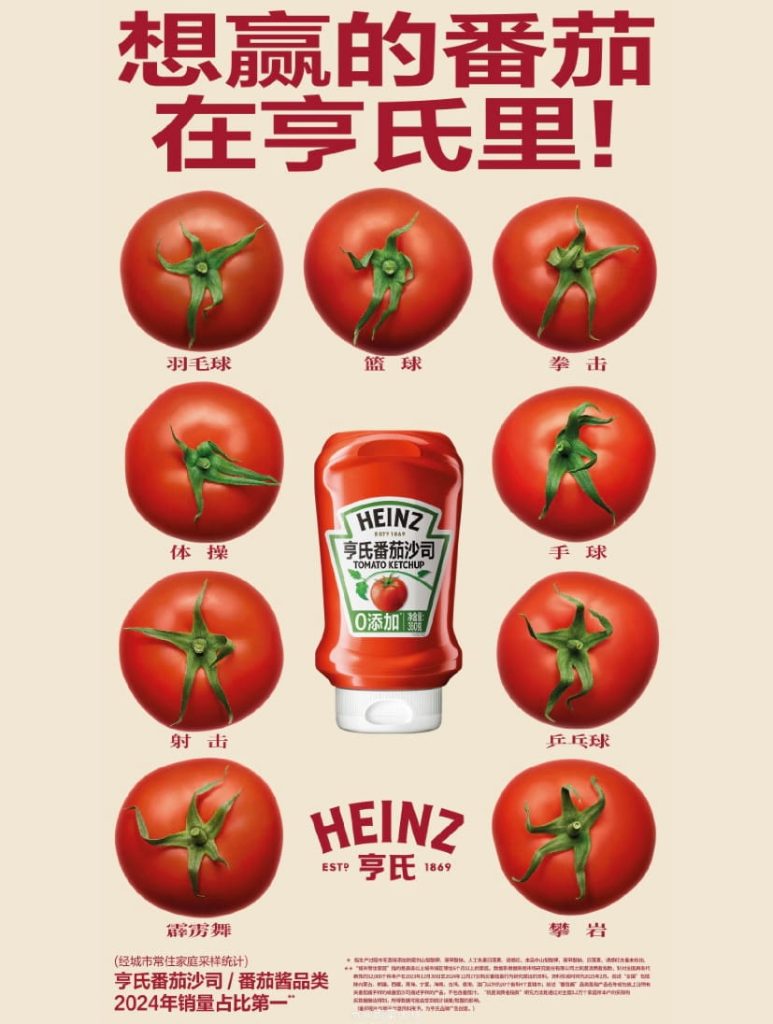
Recently, Heinz ran a creative campaign during the National Games.
They produced a TVC and a set of visuals featuring real tomatoes — each tomato’s stem shaped like someone doing a sport. The campaign ran both online and offline. And real consumers actually stopped in subway stations to look at it. Others shared and discussed it on social platforms.
I believe this campaign will end up like Nike’s long-lasting example — remembered and talked about by real consumers, long after its media buy ends.
Will a creative campaign like this bring in actual orders?
I don’t have the data.
But I believe it will.
So what’s the real value of this Heinz campaign for us?
It shows something simple:
When most brands are chasing low-risk and high-control content, the work that actually gets “seen” is the work with a bit of creative looseness.
Consumers aren’t avoiding ads — they’re avoiding ads that feel tiring to sit through.
Mixed-format content isn’t the problem; overused repetition is.
Creativity doesn’t fight KPIs — it opens the door for them.
For brands entering China or planning to grow here, one takeaway matters:
In mature markets, creativity makes you different.
In China, creativity helps you get noticed.
These are just some thoughts I had after seeing the Heinz campaign.
Marketing teams — both brand and agency — are navigating many challenges right now and adjusting constantly.
But there’s still more room in how we communicate with consumers.
Sometimes the simplest way forward is to let advertising be what it once was — an idea that earns a moment of attention.
← Back to All Articles
← Learn more about my services
You May Also Like:
Is It Still Worth Entering the Chinese Market?
China remains full of potential, but its entry logic has shifted. This piece looks at how global brands can adapt to new realities and platform dynamics.
Ready to take your content further?
Let’s build a strategy that resonates in the Chinese market.
THE OLIVIA WAY
© 2025 THE OLIVIA WAY. All rights reserved.