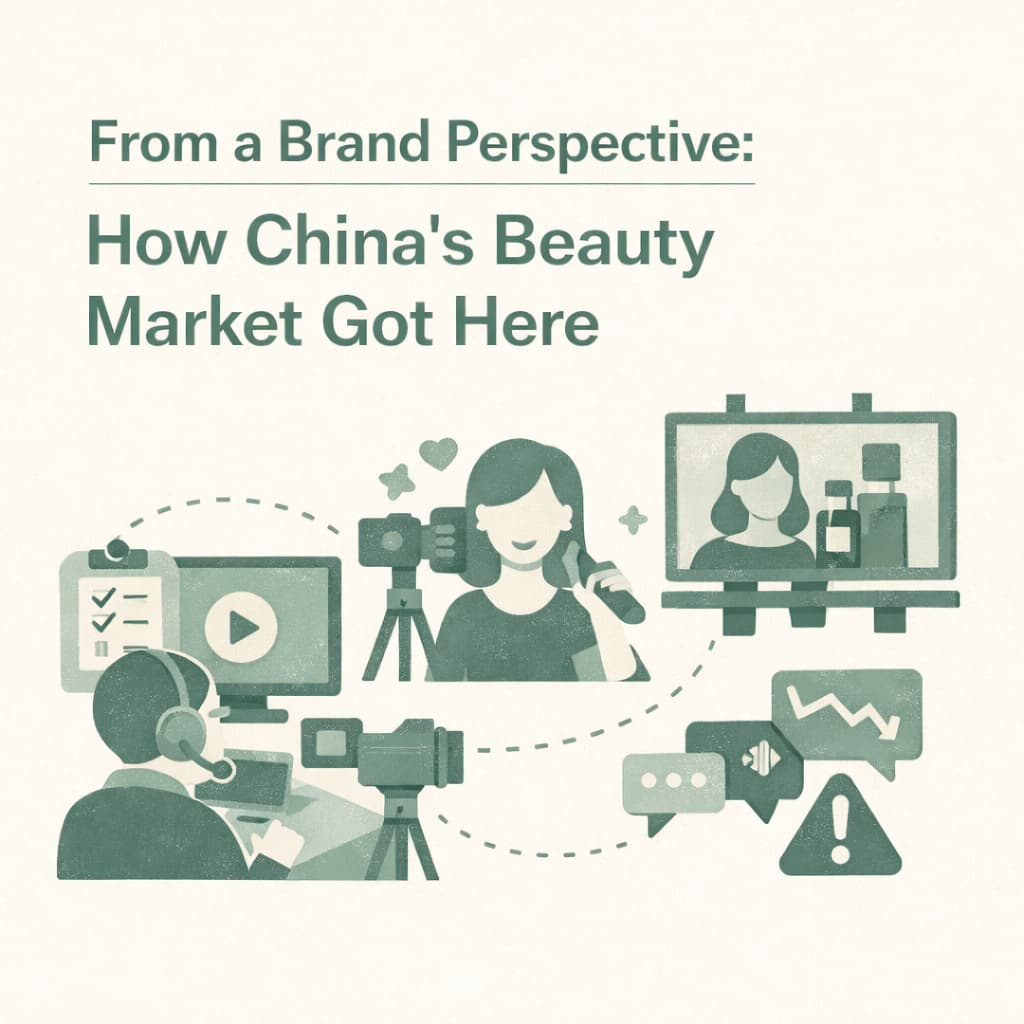
From a Brand Perspective: How China’s Beauty Market Got Here
By The Olivia
Independent Content Strategist for the China Market
This post is part of the “Marketing in China” series. Click here to view the series introduction and why it was created.
How China’s Beauty Market Changed — Seen from the Brand Side
If we look at China’s beauty market through a brand lens, its evolution can roughly be understood in three stages.
Stage One (approx. 2005–2013)
This was a period when traditional advertising still worked. Brands had near-total control over messaging. The playbook was simple: produce ads, buy channels, repeat product claims. Visibility translated directly into influence. More exposure meant more impact.
Stage Two (approx. 2014–2018)
This was the rise of beauty KOLs, and the moment traditional advertising began to lose its edge.
Brands partnered with creators whose style and personality aligned with the brand. KOLs spoke on the brand’s behalf, using their own voice, credibility, and relationship with audiences to carry the message.
Stage Three (approx. 2019–present)
As platforms became deeply commercialized, beauty content entered a phase of large-scale production. Brands remained the dominant decision-makers, but expression grew more cautious, standardized, and repeatable. Content relied less on individual style and more on systems. Scale and frequency became the primary tools for offsetting uncertainty and maintaining stable exposure.
Brands Today Are Doing a Lot
Brands now have to manage content across multiple platforms, shift between formats like images, video, and livestreaming, work with KOLs, coordinate different layers of ambassadors, and constantly align with promotional and seasonal campaigns.
To keep this system running, brands invest heavily in people, production, and media. Results are hard to predict in advance, and performance often has to be validated through volume. At its core, this approach treats scale, frequency, and coverage as a way to hedge against uncertainty and achieve more predictable outcomes. In the short term, it still functions.
Where the Problems Begin to Surface
Beauty content on Chinese social platforms has become saturated, but returns have not grown in parallel. Content volume continues to rise, yet users increasingly struggle to remember which brand is speaking. This points to a clear shift: brands are entering a phase of diminishing marginal returns, where each additional unit of content delivers less impact and weaker brand recall.
In this environment, content gradually turns into a risk-hedging tool. When single posts are unpredictable and individual platforms unstable, the most executable response becomes simple expansion—more content, broader coverage, higher frequency.
Once content stops helping users make decisions and instead exists mainly to offset risk, only one option remains: keep scaling. And when scale becomes the only solution, declining efficiency is almost unavoidable. Costs rise, but certainty does not increase at the same pace.
Final Thoughts
At this point, simply “doing more content” is no longer enough.
What matters is whether consumers can clearly understand one thing:
Is this brand right for me? Should I choose it now?
If content fails to answer those questions, then no matter how much is produced or how much is invested, it becomes difficult to convert effort into actual consumer choice.
——
About This Series
If you’d like to explore this question from different angles, you may also read:
- How Did China’s Beauty Industry Get Here?
- Extension I: From a Brand Perspective: How China’s Beauty Market Got Here (this article)
- Extension II: How Beauty Copy in China Changed Over Time
← Back to All Articles
← Learn more about my services
You May Also Like:
Where Brand Storytelling Really Works in China
An exploration of how brand storytelling functions in the Chinese market, and why its real influence lies less in persuasion and more in shaping trust over time.
Ready to take your content further?
Let’s build a strategy that resonates in the Chinese market.
THE OLIVIA WAY
© 2025 THE OLIVIA WAY. All rights reserved.